
Ask what guests remember from a gala, and the answer is rarely the menu printed on the invitation.
They remember the room. The conversations. The moment a chef finished a dish in front of them, or a warm plate arrived with just the right detail. They remember how the evening moved.
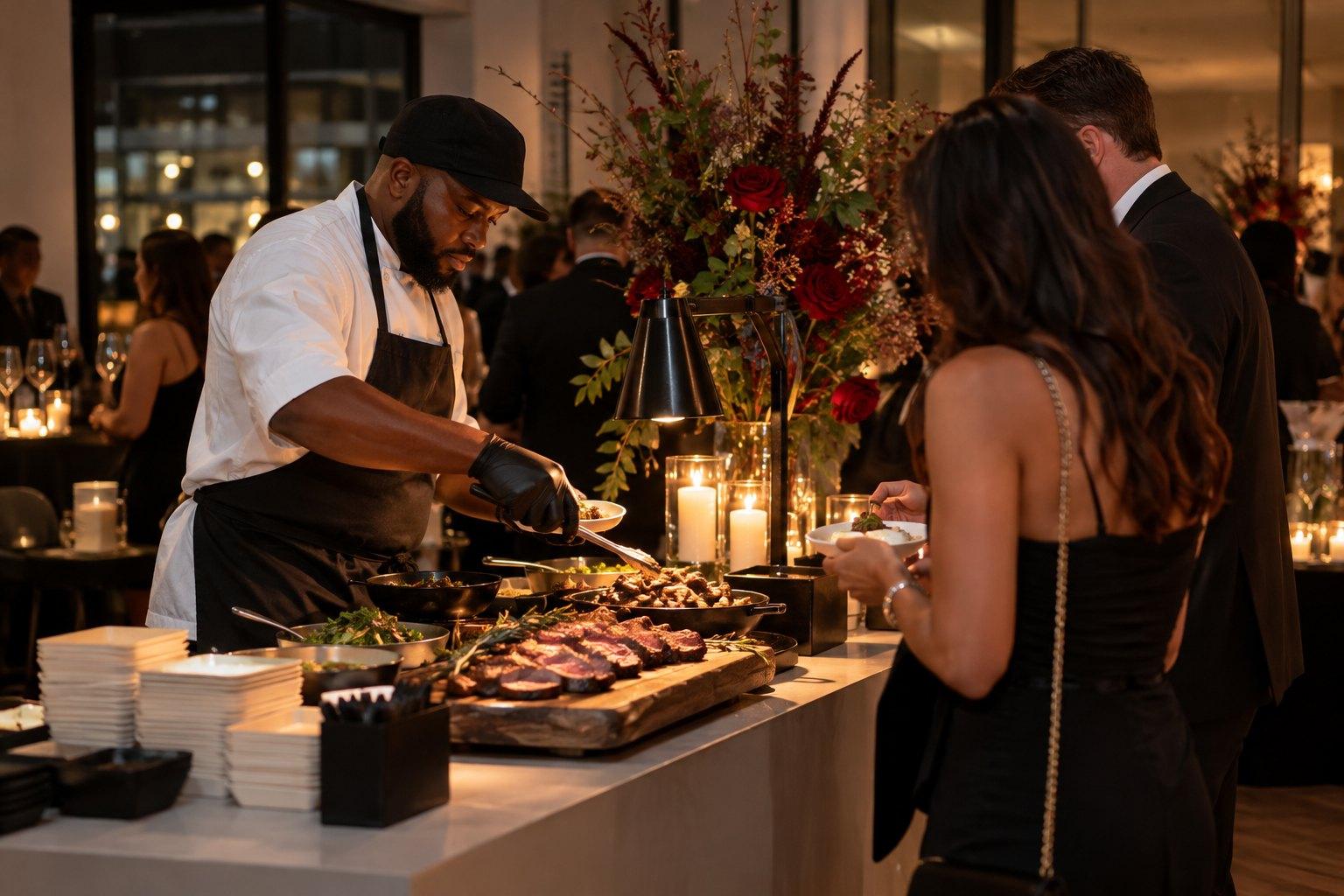
That is why chef action stations are becoming a defining choice for high-dollar Dallas galas, philanthropic dinners, cultural gatherings, and brand events. The format does more than serve food. It gives the evening a visible point of energy, creates a reason to gather, and turns culinary execution into part of the event design.
For hosts planning an experience where every element should feel considered, that distinction matters.
Treat food as part of the room
A chef action station is a live culinary environment where food is prepared, finished, carved, plated, or customized in front of guests. It may be a carving station, a fresh pasta counter, a wood-fired element, a composed dessert moment, or a seasonal ingredient display with chef-led finishing.
The best stations do not feel like an interruption to the room. They feel native to it.
This is especially relevant for galas and brand events, where visual language, guest movement, and atmosphere are carefully planned. A station can echo the materials of the venue, reinforce a campaign palette, or introduce a tactile moment within a more formal program.
At Knife & Faulk, this is the foundation of our approach to brand experiences: food operates as a spatial and sensory element, not a separate service layer. Menu, presentation, and service are developed alongside the larger production.
Design the guest flow
A station changes how guests move through an event.
A seated meal creates a clear sequence: guests arrive, sit, dine, and depart. An action-station format is more fluid. It supports mingling, gives guests a reason to move through the space, and creates natural points for conversation.
That flexibility is valuable at a Dallas gala, where guests may be balancing a program, reception, auction, performance, or sponsor activation. It is equally useful at a brand event, where the goal may be to encourage discovery rather than direct everyone toward a single dining area.
Start with the room, not the menu.
A high-impact station (such as carving, fire cooking, or made-to-order plating) can anchor a central area and create a visible culinary moment. Ingredient-led stations, such as seasonal grains, mezze, or composed salads, can support lounges and quieter gathering points.
For planning purposes, one action station for approximately 50 to 75 guests can be a useful starting point, though the right number depends on menu complexity, service timing, guest demographics, and whether passed food or seated dining is also part of the evening.
The goal is not to create lines. It is to create rhythm.
Stations should open in sequence, replenish continuously, and give guests multiple ways to participate without crowding one area. When the layout is right, the room feels active but never congested.
Build around the season
Seasonality gives live stations their strongest sense of place.
In North Texas, that might mean bright spring vegetables, chilled seafood, and herb-forward preparations in warmer months. Fall and winter can bring roasted squash, braised meats, root vegetables, warm grains, and composed desserts finished to order.
Seasonal sourcing also gives a station a narrative. Guests can see the ingredients, understand the preparation, and experience the food at its best rather than encountering a generic menu detached from the setting.
A winter gala might feature a carving station with a carefully selected cut, warm sauces, and refined accompaniments. A spring benefit could center on market vegetables, delicate seafood, and fresh herbs. A brand activation might translate a product story into a focused ingredient display or a signature bite prepared live.
The station should have a clear point of view. Three or four thoughtful elements are usually more effective than a crowded display trying to communicate everything at once.
Make dietary care visible through precision
A premium culinary experience should feel welcoming to every guest at the table.
Action stations can support dietary needs well, but only when those needs are built into the design from the beginning. This is not simply a matter of placing a gluten-free label beside a dish. It requires menu planning, ingredient control, dedicated utensils, clear communication, and staff who understand the service standard.
For guests with celiac disease, cross-contact is a serious concern. The Celiac Disease Foundation offers guidance on the importance of avoiding gluten exposure. At an event, that principle translates into practical decisions:
- Identify gluten-containing ingredients before the menu is finalized.
- Create a dedicated celiac-safe pathway where appropriate.
- Use separate utensils, vessels, and preparation surfaces.
- Train the team to answer questions accurately and calmly.
- Label dietary options clearly without making them feel secondary.
The same care applies to vegetarian, vegan, halal, nut-free, and other dietary requirements. A dedicated plant-based station can be as visually compelling and substantial as a protein-focused station. A well-designed dietary option should feel intentional, not like an accommodation added at the edge of the menu.
This is where planning creates ease. Guests receive clarity, hosts receive confidence, and the event maintains one cohesive visual and culinary language.
Staff for the moment
Live cooking is both hospitality and production.
The chef must execute accurately, maintain pace, keep the station composed, and engage with guests without allowing the performance to become distracting. Behind that visible moment, additional team members manage replenishment, sanitation, service ware, line movement, and timing.
That requires more than adding a chef to a buffet.
A well-run station typically depends on clear roles:
- A chef or culinary lead handles the visible preparation.
- A station attendant manages guest interaction and finishing details.
- A service team monitors replenishment, cleanliness, and flow.
- An event manager coordinates the station with the broader program.
The station should look effortless because the work behind it is organized.
At Knife & Faulk, our services are built around complete execution, from menu development and event management to service and cleanup. For complex galas, cultural programs, and brand productions, the station is planned as part of the full environment rather than treated as a standalone rental or menu add-on.
Brief your caterer with purpose
The most useful catering brief does not begin with, "What stations do you offer?"
Begin with the experience you want to create.
Share the guest count, venue, event format, program schedule, audience, and reason for the gathering. Then clarify how food should function within the evening.
Consider these questions:
Define the role
Should the station serve as the primary meal, a late-night moment, a reception feature, or a single culinary focal point?
Map the movement
Where do guests enter, gather, sit, view the program, and transition between spaces? Which areas should feel active, and which should remain open?
Select the contrast
Do you need one strong centerpiece, or a sequence of smaller stations? Pair a visible hot station with a quieter ingredient-led element to create balance.
Discuss the details
Ask how the caterer will manage seasonality, dietary needs, signage, replenishment, staffing, power, heat, ventilation, and cleanup. These operational details shape the guest experience as much as the menu itself.
Align the aesthetic
Share the materials, palette, and visual references guiding the event. The station should belong to the environment through its surfaces, vessels, uniforms, lighting, and presentation.
Confirm the timing
Clarify when each station opens, how long it serves, and how it coordinates with speeches, performances, auctions, or brand programming.
A thoughtful caterer will use this information to recommend a station mix that is both beautiful and workable.
Create a show without complication
The appeal of action stations is not spectacle for its own sake.
It is the way a well-designed station makes an elevated meal feel more immediate. Guests see the craft. They understand the ingredients. They participate at their own pace. The experience feels generous without becoming formal or overproduced.
For Dallas galas and brand events, that balance is increasingly important. Hosts want distinction, but they also want a room that feels natural. They want precision without stiffness, and visual impact without sacrificing service.
Chef action stations offer that balance when they are designed as part of the evening, not placed beside it.
Food becomes a gathering point, a design element, and a moment of connection. The execution remains composed. The experience feels easy.
For a gala, cultural program, or brand activation across North Texas, start a conversation with Knife & Faulk about how live chef stations can shape the room.
This article first appeared on LinkedIn.